New Cayenne for 2010

Porsche Cayenne – it’s the perfect complement to a 911 for those days you need to carry passengers or lug loads. So we’re impressed by the first pictures of the all-new Cayenne for 2010. Up until now, Cayennes have been thirsty beasts, so the introduction of the S Hybrid is no surprise. The combination of the sophisticated drive and a massive 180kg weight saving means the car is capable of 34.4mpg (New European Driving Cycle) which in anyone’s books is good. Here is Porsche’s description of the Hybrid: “In the intelligent interaction of the three-litre supercharged V6 and the electric motor, the Cayenne S Hybrid focuses on maximum efficiency from the overall system. Depending on driving conditions, the vehicle reaches this target with either only one drive unit operating by itself or with both drive units working together. In this context the 34 kW (47 hp) electric motor is of course the ideal partner for the 333 hp compressor engine with its high torque at low speeds. Together, the two drive units deliver maximum system output of 380 bhp and peak torque of 580 Nm/427 lb-ft at just 1,000 rpm, with the same kind of performance as the Cayenne S with its V8 power unit. “The two drive units are connected to one another by a separator clutch masterminded by the Hybrid Manager. Indeed, this separator clutch is essential to run the Cayenne S Hybrid either on its electric motor or combustion engine alone, or with both drive units operating together. Given a reserved, moderate style of motoring, for example in a residential area, this allows the driver to cover short distances on electric power alone and therefore absolutely free of emissions and with hardly any noise, driving at a speed of up to 60 km/h or almost 40 mph. “To ensure fast acceleration when setting off, the electric motor may however serve to provide additional thrust through its boosting effect. Intelligent management of the separator clutch makes the transition among the hybrid-specific driving modes most inconspicuous, comfortable and quick for the driver. At the same time the combustion engine may be completely switched off at speeds of up to 156 km/h or 97 mph, being fully disengaged from the drivetrain when no further power is required. In this so-called sailing mode, cruising along without power, the drag forces exerted by the combustion engine and their braking effect are eliminated in the interest of lower drive resistance and fuel consumption.” If you’d rather be a badge-carrying Global Warmer, then you’ll be delighted that you can still buy a Cayenne Turbo, with a 4.8-litre V8 that generates a worthwhile 500bhp. Even this manages to return 27.6mpg, though. In all, there are five models in the new Cayenne range: Cayenne, Cayenne Diesel, Cayenne S, Cayenne S Hybrid and Cayenne Turbo.

911 GT3 R Hybrid

This is a hybrid version of a racing 911 which features two electric motors driving the front wheels, in addition to a conventional 4.0-litre, 480bhp flat-six/rear-wheel drive configuration in the back. The car will be launched at Geneva and make its racing debut in Nürburgring long-distance events, including the 24 Hours meeting on May 15-16 2010.

Instead of batteries, the two 60kW electric motors use energy obtained from braking as a power source. A ‘flywheel generator’, with a rotor spinning at speeds of up to 40,000rpm, allows the motors to convert the ‘wasted’ heat energy of braking into stored energy for brief bursts of power under acceleration.

In effect, the motors double as both generator and power source.

On the face of it, it would appear to be similar to the ill-fated ‘KERS’ system in Formula One. The flywheel is located next to the driver for optimum weight distribution. As a result of the new system saving energy, the ‘rolling laboratory’ will be more fuel efficient, too – vital in a 24-hour race.

The company is playing down the chances of the new car scoring an overall victory at the ‘Ring in May, however.

2010 Porsche Porsche 997 Turbo S

Porsche has unveiled a new 911 Turbo S supercar. Making its debut at the 2010 Geneva motor show, it’s the first appearance of the uprated Turbo in the 911 lineup for six years.

Previously the Turbo S has appeared as a run-out special as both 993 and 996 versions of the 911 reached replacement, but this 997 iteration is a range-topping model in its own right.

And it’s usefully more powerful than the current, standard turbocharged 997 – the Turbo S boasts 523bhp and 516lb ft, respective rises of 30bhp and 37lb ft. Impressively, the fuel economy remains at 24.8mpg. Not a typical evo selling point, we admit, but it’s a rather good figure for a four-wheel-drive supercar.

That four-wheel traction, plus the standard fitment of Launch Control, means a 0-62mph-time of 3.3sec is claimed, with 124mph arriving in 10.8sec and a 196mph maximum. We’ve bettered those figures in a standard 911 Turbo already, though, and you can see Chris Harris going for a full-bore start on video here.

The 997 Turbo S will set you back £123,263 in Coupe form and £130,791 if you fancy a drop-top. That may sound steep, both representing rises well north of £20K, but the pricing appears far better value when you delve deeper: no important option box has gone unticked, with paddle-equipped PDK dual-clutch auto transmission, dynamic engine mounts, Porsche torque vectoring, Sport Chrono and ceramic brakes all standard. There are some lovely 19in RS Spyder alloys on the outside and swathes of leather and luxury inside, too.

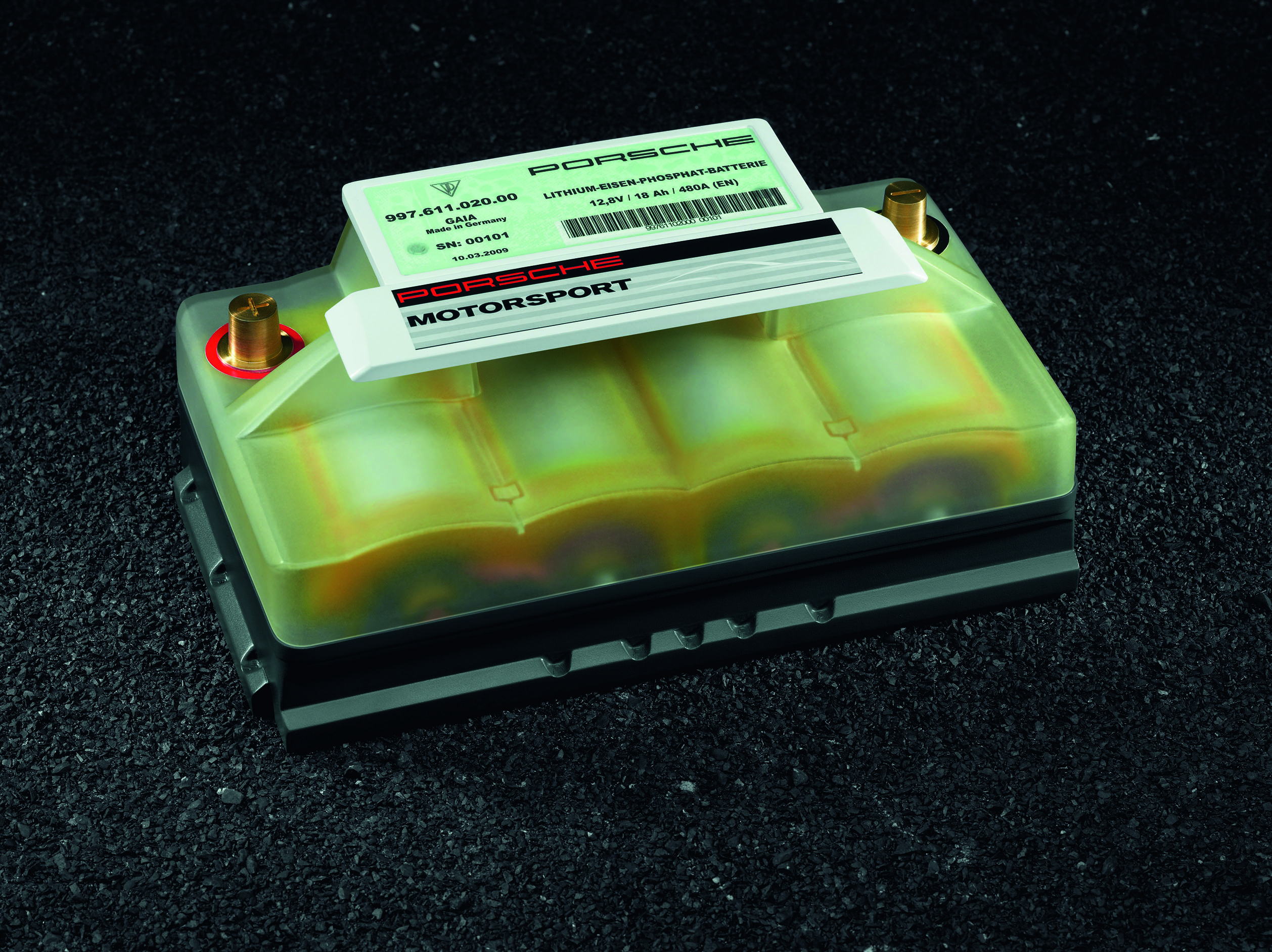
World-beating lightweight battery from Porsche

Trust Porsche to make something as mundane as a battery into something sexy and desirable!

The Lithium-Ion battery is a new option for the 911 GT3, GT3 RS and Boxster Spyder and is smaller and lighter than a conventional battery. It is also more efficient in that it almost 100 percent of its capacity is available for use (compared to 30 percent with other car batteries), and it also charges faster.

The lightweight battery is made up of four cells and integrated control electronics. This battery management system protects the battery from major discharge and guarantees a consistent charge level within the individual cells. Once battery voltage drops below a certain threshold, a warning signal reminds the driver to re-charge the battery either simply by driving the car through the power of the engine running or by means of a conventional battery charger.S10_0157_a5 The battery will also be offered as a retrofit for existing owners.

Next-generation 911

Next-generation 911

Porsche 911

Text: Jack Rix / Photos: SB-Medien/Automedia

27th January 2010

It might look familiar, but these are the best shots yet of the next-generation Porsche 911, codenamed the 998, that will replace the current car in 2011. As with every iteration of the iconic 911, styling changes are subtle although there are some interesting features on this test mule that will whet the appetite of 911 fans.

Don’t be fooled by the 911 Turbo-style air intake in front of the rear wheel arch. On closer inspection it’s nothing more than a sticker – Porsche engineer’s idea of a joke in an attempt to confuse any onlookers. And judging by the light camouflage the front and rear bumpers have been remodelled very slightly.

Up front the headlights sit a fraction more upright, while below them is a set of dazzling LED daytime running lights. The side indicators are now also LEDs. Panamera-inspired wing mirrors are no longer mounted in the corner of the front windows, but on the shoulder of the bodywork, creating better visibility for the driver.

The oversize rear boot-lip spoiler looks like a tribute to the legendary 959 hypercar, but it won’t be on the production car. It’s job is to mask the rear end – fueling rumours that an all-new retractable rear spoiler will be making an appearance.

Expect the same direct-injection flat-six engine from the current car to be carried over, with a mild power hike of course, and coupled to a reworked version of the PDK dual-clutch gearbox.

Porsche 911 GT3 R


480bhp, 4-litre flat-six powers 1200kg

This is the view most other competitors will get of Porsche’s latest FIA GT3 contender.

The latest production-based racer from Porsche looks mighty impressive. Packing a 4-litre flat-six producing 480bhp, the 1200kg car carries more aerodynamic devices and bigger wheels than many a GT1 or GT2 car of only a few years ago.

“Since we first announced our intention to launch the 911 GT3 R, demand has been huge,” said Uwe Brettel, Head of Motorsport Sales.

“The number of GT3 R vehicles we had planned for 2010 is almost sold out.” Customer teams from around the world will receive the latest cars in just a month or so. The 911 GT3 R carries a base price of 279,000 euros (plus national VAT) and will be shown to the world for the first time at the January 14 – 17 Autosport International show in Birmingham.

Compared with the outgoing model, the Stuttgart company’s latest GT3 contender is wider, has a more adjustable rear wing, includes ABS braking and traction control, and has an ‘e-gas’ with ‘throttle-blip function’ accelerator. The latter is designed to “help pilots familiarise themselves quicker to the new GT3 race vehicle”.

Gosh, in this category, if you can’t match the revs to road speed yet, I think you’re going to be in a bit of trouble come the first corner.

As with its predecessor, the new car is based on the homologated, extra-wide-body, street-legal Porsche 911 GT3 RS.


Porsche Considering Three-Cylinder Engine For 2012 Boxster

January 4th, 2010 Porsche is in the midst of developing its next-generation Boxster sports car, which has been seen undergoing testing in prototype form on a number of occasions in recent months. The new car is expected to go on sale late next year as a 2012 model and according to a new report Porsche may be planning a special fuel-efficient model. A rumor alleging that Porsche insiders are talking about a lightweight, turbocharged four-cylinder platform for the 2012 Boxster recently began making the rounds, however, the car’s model line director, Hans-Jurgen Wohler, has revealed to Autocar that a turbocharged three-cylinder powerplant may even be possible. Installing a downsized engine would be one way for Porsche to reduce its fleet emissions in line with tough new government standards coming into play in the U.S. and Europe over the next couple of years. “A Boxster with a four-cylinder engine, or maybe even a three-cylinder turbo, could produce between 180 and 200 horsepower,” said Wohler. “Given the Boxster’s history–that it started with a 200 horsepower, 2.5-litre engine–I think this is possibly something that customers could accept. The thought coincides with possible rumors of a revived 914 that could be co-branded by both VW and Porsche, targeted at different market sectors, which means the new Boxster could certainly be fitted with a compact turbocharged mill. If that’s the case, we’re sure Porsche will still offer a six-cylinder option for upper range models. [Autocar]

Porsche is in the midst of developing its next-generation Boxster sports car, which has been seen undergoing testing in prototype form on a number of occasions in recent months. The new car is expected to go on sale late next year as a 2012 model and according to a new report Porsche may be planning a special fuel-efficient model.

A rumor alleging that Porsche insiders are talking about a lightweight, turbocharged four-cylinder platform for the 2012 Boxster recently began making the rounds, however, the car’s model line director, Hans-Jurgen Wohler, has revealed to Autocar that a turbocharged three-cylinder powerplant may even be possible.

Installing a downsized engine would be one way for Porsche to reduce its fleet emissions in line with tough new government standards coming into play in the U.S. and Europe over the next couple of years.

“A Boxster with a four-cylinder engine, or maybe even a three-cylinder turbo, could produce between 180 and 200 horsepower,” said Wohler. “Given the Boxster’s history–that it started with a 200 horsepower, 2.5-litre engine–I think this is possibly something that customers could accept.

The thought coincides with possible rumors of a revived 914 that could be co-branded by both VW and Porsche, targeted at different market sectors, which means the new Boxster could certainly be fitted with a compact turbocharged mill. If that’s the case, we’re sure Porsche will still offer a six-cylinder option for upper range models.

Porsche 9ff TR1000 Hits 391.7km/h

The TR1000 is 9ff’s second fastest and strongest Porsche they have ever tuned. First place is for the GT9-R with its output of 1,120bhp. The 997 Turbo produces a whooping 1,000bhp! That is enough power for a sprint from standstill to 62mph (100km/h) in just 3.2 seconds. After 16 seconds the TR1000 passes the 188mph (300km/h) barrier.

The Ruf Stormster electrifies Porsche’s Cayenne.

Ruf Automobile GmbH is known for building some of the fastest Porsche-based cars ever created, such as the Rt 12 with which we hit 217.1 mph on the Autobahn one dark evening in Germany in 2005. But in a nod to alternative propulsion methods, this small company situated in the Bavarian town of Pfaffenhausen has lately strayed from 700-bhp twin-turbo gasoline-powered flat-6 engines to battery-powered electric motors: To wit, the new Ruf Stormster.

Based on Porsche’s Cayenne SUV, the Stormster, says Ruf, is the very first electrically-powered Cayenne. A Siemens electric motor provides the Stormster’s propulsion, putting out 270 kW, or the equivalent of 367 hp. This is the same motor that powers Ruf’s Greenster 911-based electric sports car, itself an evolution of the eRuf concept that we test-drove in the December 2008 issue of R&T. The lithium-ion batteries in the Ruf Stormster come from Li-Tec Battery of Germany.

Ruf says the Stormster, with a total vehicle weight of 5886 lb. (which is a little over 1000 lb. heavier than the Cayenne V-6), hits 100 km/h (62 mph) in 10 seconds, and can continue on to a not-exactly-hair-raising top speed of 93 mph. But possibly the most important performance figure for the Ruf Stormster is its claimed range of 124 miles between charges. The all-wheel-drive Ruf Stormster rides on specially developed Hankook winter tires (size 295/30R-22) fitted to Ruf’s classically understated lightweight 5-spoke wheels.

The Ruf Stormster is currently on display in Copenhagen, Denmark, at the United Nations Climate Change Conference. Certainly a fitting launching ground.

Porsche Boxster Spyder

The new Boxster Spyder is due next year, inspired by the legendary James Dean 550 Spyder.

Auto Express Car Reviews By Luke Madden 05th November 2009

The most treasured model in Porsche’s history, the Spyder, is about to take to the road again! The German company has announced the release of a new lightweight, driver-focused version of the mid-engined Boxster, known as the Boxster Spyder.

Inspired by the 1954 550 Spyder, which stood only three-feet high and weighed a slender 550kg, the Boxster Spyder sports a new, low-slung silhouette with a lightweight, low-lying soft-top and windows.

Completing the look is a pair of humps which extend across the boot-lid to the rear spoiler and transform the normally awkward looking Boxster into something that more closely resembles the Carrera GT supercar.

Due to be unveiled at the Los Angeles Motor Show in December, the new car weighs in at just 1,275kg, which is 80kg less than the Boxster S and enough to make it the lightest Porsche on sale today.

Under the bonnet, the Spyder uses Porsche’s tried and tested 3.4-litre ‘boxer’ engine, newly tweaked to put out 320bhp. The uprated engine can be paired with a standard six-speed manual gearbox or the PDK twin-clutch system, which has now done away with its counter-intuitive steering wheel mounted controls in favour of a pair of paddle-shifters.

Porsche claims that a Spyder, fitted with the optional PDK gearbox and Sports Chrono Pack will sprint to 60mph in a blistering 4.8 seconds, that’s almost a second quicker than a PDK equipped Boxster S. Top speed is more familiar, with the Spyder’s top speed of 166mph only 3mph more than the S.

Renowned for its responsive handling and excellent brakes, the original Boxster package is hard to improve, but that hasn’t stopped the Porsche engineers from trying. A lower centre of gravity coupled with a slightly revised suspension set-up allows the Spyder to be even more agile than its predecessor.

However, the new Porsche isn’t just about torque and tyresmoke; consumption figures of 30.4mpg, again with the optional PDK gearbox, should help cut down time spent at the pumps and should also save around £200 a year in road tax over the standard Boxster S.

The new Spyder will go on sale in February 2010.