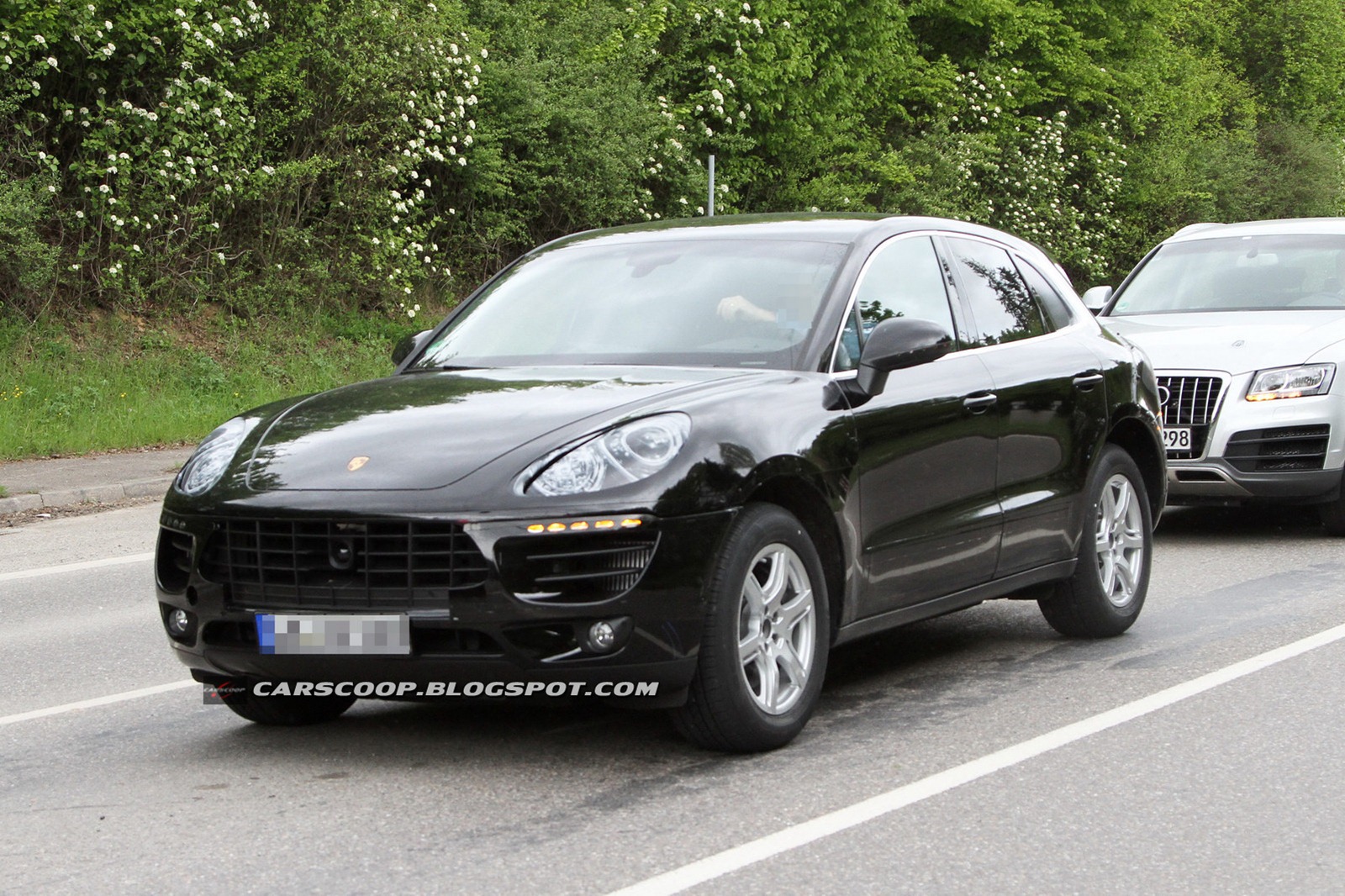
The Porsche Macan – carscoop

the Porsche Macan as the Stuttgart automaker’s engineers took a completed prototype for a ride in Germany and our spy photographers were on hand to capture it on film.

Lifting a page from the 911 prototypes, Porsche’s people added some goofy-looking head- and tail lamp covers mimicking the style of the larger Cayenne to confuse us, but the rest of the car matches the teaser sketch released by the company in February during the announcement of the name.

The overall exterior styling is very close to the Cayenne but the Macan is smaller in size and features a swoopier roofline.

The Macan shares its platform architecture with the Audi Q5, which means its key dimensions will be similar to Ingolstadt’s crossover model.

From what we have heard, the two models will also share key hardware components such as gasoline and diesel engines, steering, transmission, axles and even Audi’s Quattro four-wheel-drive with Porsche developing its own braking, suspension and dynamic control systems to provide sportier handling characteristics.

It’s still early to know precise details about the engine range, but we could see Porsche offering the Macan with the 2.0-liter TFSI and 3.0-liter TFSI petrols along with a 3.0-liter TDI diesel and possibly even the Q5 Hybrid’s driveline.

Porsche has confirmed that the Cayenne’s baby brother will begin production at its Leipzig facility in Germany next year.

Ruf RGT8

Ruf has unveiled its new RGT8 at the Geneva motor show. It’s the company’s interpretation of a V8-engined Porsche 911, and after its 2010 launch in 997 guise, there’s a new, 991-based model.
Porsche’s tried and tested flat-six drivetrain makes way for a flat-crank, dry sumped 4.5-litre V8. It’s naturally aspirated, and delivers 542bhp and 369lb ft of torque to the rear wheels. It serves up more power than the Porsche 997 GT2, but without that car’s twin turbos. And Ruf is keen to talk up the V8’s rev-happy nature and scintillating soundtrack. Its top speed is 198mph, and the RGT8 can be specced only with a six-speed manual gearbox.

991 iteration of the Porsche 911 coupe

The 2012 Porsche 911 Carrera, codenamed 991 for no particular reason other than Porsche is running out of codenames beginning with ‘9, and this one was still available, for now available as a rear-drive coupe but soon to be joined by a full pipeline of variants. The standard Carrera uses a direct-injection 3.4-litre 350bhp flat-six de-stroked from the old 3.6-litre for fuel savings, while the Carrera S has a 394bhp 3.8-litre that is mostly carry-over. The seven-speed comes as a paddle-shift PDK or, intriguingly, as a manual with an extra dog-leg to the far right for the economy cruising gear.

It’s on sale in Europe next year, but we’ve already driven it in the USA.

Technical Highlights?

Many colours are available, but all will be green(er). Aluminum bodyshell content rises to 45 percent now that the roof, floor, doors, bonnet, front wings, and forward crash box are all alloy. That holds the kerbweights down to just under those of the previous model.

On a longer wheelbase with a lower roof and wider front track, Porsche is trying out several new technologies aimed at saving fuel, including its first use of electric power steering. This risky dalliance with a known buzz-kill uses a rack-mounted motor and extensive control logic to filter out unwanted ‘noise’ through the steering while preserving what’s we’re told is ‘useful’ feedback. More petrol pinching comes from stop/start, deceleration-only battery charging, and a coast-at-idle function for PDK-equipped cars that decouples the engine in some coasting scenarios. For handling, a new active anti-roll bar uses compact hydraulic cylinders in place of stabilizer-bar links to help keep the car flatter through corners, plus a torque vectoring system that selectively activates the rear brakes in concert with a locking differential, mechanical or electronic depending on the configuration, for aiming the car at apexes.

What’s it like to drive?

It’s only 30mm longer overall, but with the windscreen center point moved out 75mm over a deeper dash, and a sloping center console evocative of the Panamera’s, the new 911 feels much bigger from the captain’s chair.

Some of the old 911’s intimacy is lost, but road noise drops considerably inside (at 80 mph you can hear the Sport Chrono clock ticking, for example) and functionality and comfort both rise – even for the long-suffering back seat passengers, who get another 30mm of legroom.

The longer wheelbase and more equitable axle-weight distribution does as advertised and imparts greater stability, so there’s less vertical bounding through turns and better front-end bite out of the corners. Note: we drove only the 3.8 equipped with the optional dynamic engine mounts, which in the previous car helped greatly in keeping the arse planted.

The steering is indeed more filtered, with most of the hyper-organic jiggles and tugging tossed out. There’s still a progressive ramp-up in steering effort that feels natural enough for a car that sells mainly to older folk who aren’t cross-shopping an Exige. The brakes are solid and trustworthy, and they and the differential give the new 911 a sharp lift-throttle turn-in that it never had before.

How does it compare?

People who have always wanted a 911 shouldn’t feel that they’ve missed their moment. The 991 is smoother, quieter, larger, more comfortable on a long drive, but it’s still fundamentally a 911.

So the basic arguments for and against remain the same if you’re looking at, say, the Jag XKR, the Maserati Gran Turismo, or a used Aston. It may be less exotic, but the 911 remains a blue-chip choice and more of an engineering wonder than its rivals.

Porsche’s next 911, the 991

, marks a big change for the iconic model. Big, that is, in terms of size. While it rides on a thoroughly reworked version of the current 996/997 platform, it will be visibly larger. Set to be unveiled this fall at the Frankfurt auto show and go on sale as a 2012 model, the 991 gets a longer wheelbase to accommodate its airier interior. The cabin’s materials and console layout will be nicer, too, with more than a passing resemblance to the Panamera’s.

Porsche started work on the 991 under former R&D chief Wolfgang Dürheimer, now at Bentley and Bugatti, and the former CEO, Wendelin Wiedeking. After Volks­wagen assumed control of  Porsche, styling changes were reportedly incorporated at the “request” of  Ferdinand Piëch.

Given the next 911’s longer wheelbase, we expect a more supple ride without a corresponding sacrifice in dynamic competence. Like every 911 before, the new model will remain rear-engined. Rear-wheel drive will, of course, be standard, and all-wheel drive—an option since the 1989 Carrera 4—will be available. The standard engine will be the naturally aspirated flat-six, likely in two displacements, as is currently the case. We don’t expect huge power increases, but Porsche will employ electric-assist steering to aid efficiency and some weight-saving measures such as more aluminum body panels.

The Turbo will remain at the top of the portfolio, and there are even plans for a hybrid version. More unexpectedly, Porsche might also offer a turbocharged flat-four. Such a model would be easy to justify historically—the 356 was a four, as was the 912. But a turbocharged four could get awfully close to the naturally aspirated six and dilute the “Turbo” moniker, which is still associated with the top-hole 911s.

Predictably, there will be a coupe and a convertible body as well as numerous variations, such as future GT2 and GT3 models. Their successive launches mean that the current 997 and the new 991 will be built alongside each other for a while.

Porsche knows the Cayman’s mid-engine arrangement is dynamically superior to the 911’s, but the latter’s rear-engine ­layout enables usable rear seats. Plus, it helps to create those classic proportions.

Porsche 911 GT3 RS 4.0

The car you see here represents the end of two eras, writes John Simister. And a third (rather short) one because all 600 examples of the new Porsche 911 GT3 RS 4.0 have already been snapped up by buyers eager for a piece of history. Of these, around 35 – one per Porsche dealer – will come to the UK. So if you haven’t placed your order, you’ll just have to imagine the RS 4.0 experience with the help of the words that follow. This is the last 997-era 911 before an all-new range is revealed at this coming September’s Frankfurt show. The next generation will still have a flat-six engine in the tail, derived from the new-generation engines already found in most 911s, Caymans and Boxsters, but the rest of the car will be a complete re-design. But there’s something else historic about GT3 911s, which is that they have never adopted this new-generation engine because the dizzy revs a GT3 reaches are too high for the new engine’s direct-injection system.

So all GT3s, including this latest one, still have an engine block directly descended from the original 911 engine of 1963, complete with dry sump and separate oil tank. Of course the cylinders and heads long since become water-cooled, with four valves per cylinder and two camshafts per cylinder head, but the line of descent is clear.
That original engine had a 2.0-litre capacity. This one, unbelievably, is double that, which makes it the largest engine that has ever hung behind a Porsche’s rear wheels. The extra capacity comes from a longer stroke, the bores already being at the limit, and it results in an extra 50bhp over the outgoing 3.8-litre GT3 RS to make 500bhp at 8250rpm. That’s 911 Turbo power, but delivered in a very different way; its torque peak is 339lb ft at 5750rpm, suggestive of the need to keep the revs flying. That ain’t necessarily so, as we shall see.

This GT3 RS is full of race-specification, or at least race-inspired, components to help it to a low 1360kg unladen weight. The engine’s connecting rods are titanium. The bonnet and front wings are carbonfibre, as is the handmade air-filter box designed to eliminate detectable pressure differences either side of the two cone filters’ elements. The rear side windows are polycarbonate, there’s a rollcage in place of the rear seats in usual GT3 fashion, and the rear wing atop the lightweight engine cover has a 9deg angle of attack instead of a regular GT3’s 5deg to give a hefty 190kg of downforce at the claimed 193mph top speed. Tiny winglets ahead of the front wheelarches help keep the front wheels in road contact while this is happening.
Underneath, we find GT2 RS-type suspension components such as the soft ‘helper’ springs under the stiff main ones, designed to absorb small bumps with acceptable suppleness, and solid Rose joints – six per side – for all the lower pivots of the rear suspension. The upper pivots retain rubber, without which the ride would be too harsh and the steering response too ‘darty’. All of the foregoing results in a 911 able to lap the Nürburgring Nordschleife in 7m 27sec, which is 3.8 seconds fewer than the GT3 RS 3.8 required and also quicker than a Carrera GT. Without the front winglets, apparently this latest GT3 would take off at the circuit’s Pflanzgarten section.
Fine. Could you live with it on the road? The engine has, at 12.4 to one, an extraordinarily high compression ratio for an indirectly injected unit, so you would expect harshness and bad behaviour if attempting to accelerate hard from low revs. There is neither. You can put your foot down at just over 1000rpm and feel a strong surge of instant torque, something GT3s to date have not offered unless already singing at several thousand. At 4000rpm there’s a deepening of exhaust note – pressing Sport (hardly a vital adjunct to a car like this) ensures the note is there from the off – and the RS really starts to hurtle as the four variable camshafts find their optimum rotational angles.

You can blaze around the lanes all day, as I did, and seldom see more than about 6000rpm on the tachometer. You can stay in a high gear and still have more overtaking urge on tap than anything else you’re likely to encounter. But if you do let the revs rip and head towards the figure eight, you’re rewarded with a truly extraordinary blast of aural and accelerative energy, a hard-edged rip which cannons you from one bend’s apex straight the point where the (£5924 optional) carbon-ceramic brakes dissipate it all before the next one. From a standstill to 62mph takes 3.9sec, to 124mph under 12.

All the while the RS steers with a precision that’s simultaneously meaty and delicate, rear end squirming slightly as power and topography attempt an accommodation, nose always glued. Your sense of balance lets you know the engine is behind you, but such are the grip and the traction that pendulous oversteer just doesn’t materialise. Not on a dry road, anyway; a wet race track might be another matter. It rides well, too, on its two-range adaptive dampers. Probably better than the Carrera GTS recently tested here, actually.
Just two snags. Surprisingly, heel-and-toe pedal work was very difficult in the left-hand-drive test car, which was probably just a matter of accelerator adjustment. And you do find yourself wondering just how you can enjoy all this pace on our crowded roads without becoming a social outcast. You need either to live somewhere like Northumberland or have a regular trackday date.

Oh, and the price list starts at £128,466, with an extra £1295 for the rather cool, ultra-lightweight, lithium-ion battery. But it doesn’t matter, because they’ve all gone.
John Simister

Porsche Panamera Turbo S

Porsche has released details of its latest Panamera, the range-topping Turbo S.

Its twin-turbo V8 engine boasts 542bhp and 553lb ft, up 49bhp and 37lb ft over the regular Turbo. A further 37lb ft of torque is available courtesy of an overboost function; a 590lb ft total spread between all four wheels should provide pretty vivid performance. Porsche claims a 0-62mph figure of 3.8sec, bettering the Turbo by 0.4sec and even a Porsche 911 GT3 RS by 0.2sec.

The top speed has also marginally increased over the Turbo, up 3mph to 191mph. All of this performance is kept in check by the usual array of acronyms, such as PDCC (Porsche Dynamic Chassis Control) and PTV Plus (Porsche Torque Vectoring Plus), which are standard on this model. Porsche also points out that this model is no less economical on fuel than the standard, 24.6mpg Panamera Turbo.

A faster version with few negatives, then, though the starting price for the new Panamera Turbo S is £122,623, almost £20,000 more than the standard Turbo. Your extra money doesn’t just go on outwardly invisible extra performance though, with the exterior appearance benefiting from 20in Turbo II alloy wheels, side skirts from the Porsche Exclusive range, increased rear track width and an adaptive extending four-way rear spoiler. There are also two new interior options exclusive to the Turbo S, black/cream and agate grey/cream. The Panemera Turbo S is available from June

Porsche 918 official sketches

Production-ready plug-in Porsche supercar revealed in official sketches, blends 200mph pace with 94mpg economy

Porsche’s hybrid hypercar is go! With fuel consumption of 94mpg, but a 0-62mph time of 3.2 seconds, the 918 Spyder is set to blur the line between performance and economy as never before. Only 918 examples will be made in total at Porsche’s flagship plant in Stuttgart, with production beginning on 18 September 2013 and first deliveries planned for two months later.

The price has been set at £678,000, which is nearly three times that of the new Lamborghini Aventador LP 700-4, and almost £250,000 more than the 918’s
predecessor, the Carrera GT.

Unlike the Geneva Motor Show concept, the production model will 
feature a manual roof system with removable panels that stow in the front 
luggage compartment. The side-exit exhausts have been deleted, and now emerge from pods behind the headrests. The rear wing will extend upwards for more downforce at high speed.

In keeping with the 918 Spyder’s eco-friendly approach, weight will be kept to a minimum. At the heart of this strategy is a carbon fibre-reinforced plastic monocoque carried over from the Carrera GT. Magnesium and aluminium will also be used throughout, ensuring the 918 weighs in at less than 1,500kg.

Under the skin, the plug-in hybrid powertrain is identical to the layout shown on the concept. It features a high-revving mid-mounted V8 and 
two electric motors – one on each axle – which brings the benefits of four-wheel drive.

The engine is derived from the racing unit used on the RS Spyder and will have a displacement of “more than four litres and an output of in excess of 500bhp”. Power is transmitted through 
a seven-speed twin-clutch PDK gearbox. The two electric motors have a joint output of 215bhp.

The lithium-ion battery pack can be charged from a normal power socket in as little as three hours and provides a range of 
16 miles in electric-only mode, 
at speeds of up to 94mph. It’s 
this electric-only function that allows the 918 to achieve such remarkable fuel economy of 94mpg, and corresponding 
emissions of 70g/km.

Although it potentially puts out less CO2 than a Toyota Prius, 
performance is expected to be scintillating. Porsche claims the 0-62mph sprint will take 3.2 
seconds – on a par with the McLaren MP4-12C – with a 
top speed of around 200mph. Simulations have also calculated that the 918 will be able to lap Germany’s famous Nürburgring circuit in seven minutes and 30 seconds – a few seconds quicker than the V10-powered Carrera GT.

Customers putting down a deposit will get the chance to 
buy the ultimate accessory – 
in the shape of a special 911. The Turbo 918 S Spyder Edition comes as a coupé (£125,865) or 
a cabriolet (£133,553), and will also be limited to 918 units.

Mechanically identical to the 523bhp 911 Turbo S, the limited-run model features acid-green highlights on the seats, instrument dials and 
illuminated door sills. There’s also higher-grade leather on the interior and additional carbon elements inside and out.

A badge on the glovebox 
will bear the same order number as your 918 Spyder, plus it can be ordered in the exact same 
colour. But Spyder Edition will 
be available to the public, too, with deliveries starting in June.

New leaner Porsche hybrid racer

The Porsche factory team will line up for the 2011 Nurburgring 24-Hour endurance race with a considerably updated version of the 911 GT3 R Hybrid – so much so that the team refers to the 2011 race car as Version 2.0.

Most of the development work went into making the hybrid components more compact – the hybrid system as a unit is now 20 percent lighter than previously, in an attempt to achieve the same lap times as its predecessor on less fuel.

The general layout remains the same, however; a portal axle with two electric motors drives the front wheels and supplements the 345kW, four-litre flat-six at the back – but the output of the electric motors has been increased from 60 to 75kW each.

For a few seconds at a time, drivers now have an additional 150kW on tap, either by hoofing the loud pedal extra hard or by calling the extra power up manually, for instance when overtaking.

The electric flywheel accumulator, with its rotor spinning up to 40 000rpm and storing energy mechanically, is now fitted, along with the other hybrid components, in a carbon-fibre safety cell on the passenger’s side.

The new GT3 R Hybrid is visually quite different from the 2010 model. More efficient, cooler-running high-voltage components have obviated the need for large louvres in front of the wheel arches, reducing drag and fuel consumption. And the overall weight of the car is down from 1350 to 1300kg.

Most of the displays and controls have been moved to the steering wheel.

.
Hartmut Kristen, head of Porsche motorsport, said: “We’ve collected a great deal of information from our races at the Nurburgring, the ALMS race at Road Atlanta in the US and the ILMC race at China’s Zhuhai circuit.

“The emphasis was always on improving efficiency – keeping the lap times consistent with 2010 but using less energy, hence less fuel, and supporting future development of sporty hybrid road cars.”

The cockpit of the 911 GT3 R Hybrid has also been completely revised. Most of the displays and controls have been moved to the steering wheel and the driver can operate the rest of the functions via backlit buttons on the centre console. Priority was placed on ergonomics and a clear, intuitive layout – particularly in darkness as this is, after all, an endurance racer.

1993 Porsche Boxster Concept

When the Porsche Boxster debuted in 1996, I felt like the only person in the world who wasn’t exhilarated. It’s not that I didn’t think the Boxster was a terrific car. On the contrary, at its debut the Boxster was beautiful in design and execution, a redefinition of the open-topped sports car that combined the fun of a Mazda Miata or an MGB but with a much sharper performance edge. All of those things were and are true, and by any measure the Boxster is a fantastic car.
No, I was disappointed because my heart had already been claimed by the Boxster show car that debuted in 1993 at the Detroit Auto Show. Compared to that svelte knockout, the production Boxster felt like a milquetoast disappointment. At a glance the two cars look fairly similar, but the show car was just enough more sultry, just enough more edgy and daring than the elegant but straightforward production Boxster that the show car fired adrenaline while the Boxster merely provoked admiration. Slick, smooth, tightly wrapped, and with the air of the exotic, the concept Boxster recalled the Porsche 550 RS Spyder without obvious retro pandering.

When the Boxster show car debuted, it was also fascinating in that it promised a new kind of Porsche–built only as a droptop, with the engine mounted amidships, and with a strong character of its own. At the time, the long-lived 911 was still air-cooled and had undergone only evolutionary change over the previous decade. Other 911 sidekicks–namely, the 914, 924, 944, and 928–were lauded by a few of us fanatics but didn’t really capture the world’s imagination.
The Boxster show car had the charisma to change all that–and despite the dilution required for production, the original formula was still potent enough to make the Boxster the most visible and broadly coveted Porsche sidekick since at least the 928 and possibly ever. There must be others that feel as I do about the concept–unlike most show cars, it is available as a die-cast collectible. I am the proud owner of a 1/18-scale version, which is unfortunately as close as I’m likely to get to the Boxster concept car.
Both of the photos in this post were taken by John Lamm for Road & Track. The second picture is part of a great page of Boxster photography at the Porsche Club of America.

Battery Boxster

Porsche has (almost silently) rolled out three Boxster E prototypes, each powered by two 90kW electric motors and a 29kW/h battery.

These are not concepts, says Porsche CEO Matthias Müller, but rolling laboratories that will be put into daily use to help solve the practical problems of electric vehicles in a real-world situation – and to adapt that world for electric vehicles.

No technical details have been released but Müller said the battery Boxsters would have about the same performance as the conventional models – 0-100 in five seconds and a 270km/h top speed.

Simple arithmetic, however, tells us that level of performance will run a 29kW/h battery as flat as yesterday’s souffle in about nine minutes.

Müller admitted: “Electric mobility is a central challenge of the coming years and we at Porsche have a part to play, to gain insight into requirements for future products and the inclusion of electric vehicles in the infrastructure.

The Boxster, he added, was the ideal platform for practical testing of electric drives.

“It’s very light and its mid-engine layout allows the new components – electric motors, batteries and high-voltage technology – to be safely and accessibly accommodated while still providing the performance and dynamics expected of a Boxster.”